
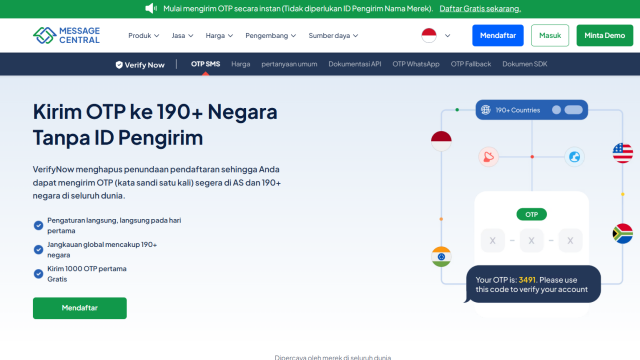
How to Choose the Best OTP Provider in 2024: Avoid Costly Mistakes
Choosing an OTP provider seems straightforward until your authentication starts failing, costs spiral, and your support team is flooded with tickets. OTP SMS remains the global backbone for secure login, transactions, and account recovery for banks, apps, and marketplaces. Selecting the wrong provider can directly hurt your conversion rates, security, and revenue.
This practical guide cuts through the marketing hype. Learn how to evaluate and select a reliable OTP provider based on real-world performance, not just promises.
Quick OTP Provider Comparison: Key Takeaways
- Delivery rate and reliability matter more than the lowest upfront price. Failed OTPs mean lost users.
- Beware of hidden costs like retry fees, fallback charges, and country surcharges that inflate your bill.
- Always run a pilot test in your target countries before committing to any provider.
- Demand built-in fallback channels (like Voice or WhatsApp) to maintain uptime when SMS fails.
- Build for flexibility to avoid costly vendor lock-in.
Why Your OTP Provider Choice Is Critical
OTPs are the gatekeeper for user onboarding, logins, payments, and account recovery. When they fail, users don't just complain—they abandon your service. A weak OTP system leads to:
- Sign-up and login drop-offs
- Failed transactions and lost revenue
- Increased fraud risk
- Overwhelmed customer support
- Damage to your brand's reliability
What is an OTP (One-Time Password)?
An OTP is a short-lived, numeric code sent to a user's device to verify their identity. It's essential for:
- Login verification and Two-Factor Authentication (2FA)
- Transaction approvals
- Password reset flows
- Account recovery processes
OTP Provider Evaluation Scorecard: 7 Key Factors
Evaluate providers on this formula: OTP Quality = Delivery Speed Reliability Cost Control.
1. Delivery Speed & Success Rate
OTPs must arrive in seconds. Ask providers for their real-world delivery success rate and average latency in your key markets.
2. Global Coverage & Fallback Options
SMS can fail. A robust provider offers automatic fallbacks to:
- Voice OTP
- WhatsApp OTP
- Push Notifications
3. Scalability & Throughput
Can their infrastructure handle your login spikes, sale days, and peak traffic without throttling or rate limits?
4. API & Developer Experience
Look for clean REST APIs, comprehensive SDKs (Node.js, Python, Java), webhooks, and excellent documentation for fast integration.
5. Security & Fraud Protection
Essential features include retry limits, replay attack protection, anomaly detection, and configurable allow/block lists.
6. Reliability & Uptime SLA
Demand at least 99.9% uptime, redundant infrastructure, and clear Service Level Agreements (SLAs).
7. Transparent Pricing Model
Scrutinize pricing for hidden fees: retry costs, fallback charges, per-country rates, monthly minimums, and volume tier jumps.
Top OTP Providers Comparison 2024
| Provider | Strengths | Considerations | Best For |
|---|---|---|---|
| Twilio Verify | Global reach, mature API, strong brand | Can become expensive at high scale | Large enterprises with global needs |
| MSG91 | Strong delivery in India, competitive pricing | Global fallback options can be limited | Businesses focused on the Indian market |
| Exotel | Good India & SEA compliance | Global coverage not as strong | Localized use cases in South Asia |
| MessageBird | Omnichannel capabilities | Pricing can be high at lower volumes | Businesses needing multi-channel flows |
| Message Central | No sender ID registration needed, 190 countries, built-in fallback | Uses shared sender ID | Startups and SMBs needing fast, global deployment |
Tip: Never rely solely on comparison tables. Conduct real-world tests in your specific markets.
Hidden OTP Cost Traps to Avoid
True cost goes beyond "price per SMS." Watch out for:
- Retry Loops: Costs from automatically resent failed OTPs.
- Fallback Charges: Each voice or WhatsApp fallback may have a higher fee.
- Country-Specific Surcharges: Rates can vary dramatically per destination.
- Artificially Inflated Traffic (AIT): Costs from bot attacks or system abuse.
- Throughput Caps: Limits that cause delays and require manual resends.
OTP Integration Best Practices
- Implement Smart Retry Logic: Use exponential backoff and cap retries per user session.
- Design a Fallback Hierarchy: e.g., SMS → Voice → WhatsApp, triggered only when needed.
- Monitor Key Metrics: Track delivery success rate, latency, fallback rate, and cost per verified user proactively.
Final Checklist Before Choosing an OTP Provider
Your chosen provider must have:
- ≥ 98% real-world delivery success rate
- Automated fallback channel support
- Fully transparent, predictable pricing
- Developer-friendly APIs & SDKs
- Real-time monitoring dashboard
- ≥ 99.9% uptime SLA
- Relevant regulatory compliance (e.g., GDPR, TCPA)
- A clear path to avoid vendor lock-in
Conclusion: Choose for Reliability, Not Just Price
The best OTP provider works invisibly in the background. A bad one creates chaos. Pilot multiple providers with real traffic, measure the actual data on speed and reliability, and choose a partner that scales with you without surprise costs or lock-in.




Artikel Terkait
Mantan Jampidsus Febrie Adriansyah Minta Seluruh Aset Sitaan Dikembalikan
Menko Polkam Tegaskan Tindakan Hukum Tegas untuk Penginjakan Garuda, Pengibaran Bendera GAM, dan Kericuhan Demo Papua
Gempa M 7,7 di NTT Tewaskan 47 Orang, 5.434 Warga Mengungsi
Wacana Cetak Ulang Buku Pelajaran Menuai Kritik: Ekonom Soroti Pemborosan Anggaran dan Nasib Buku Sekolah Elektronik